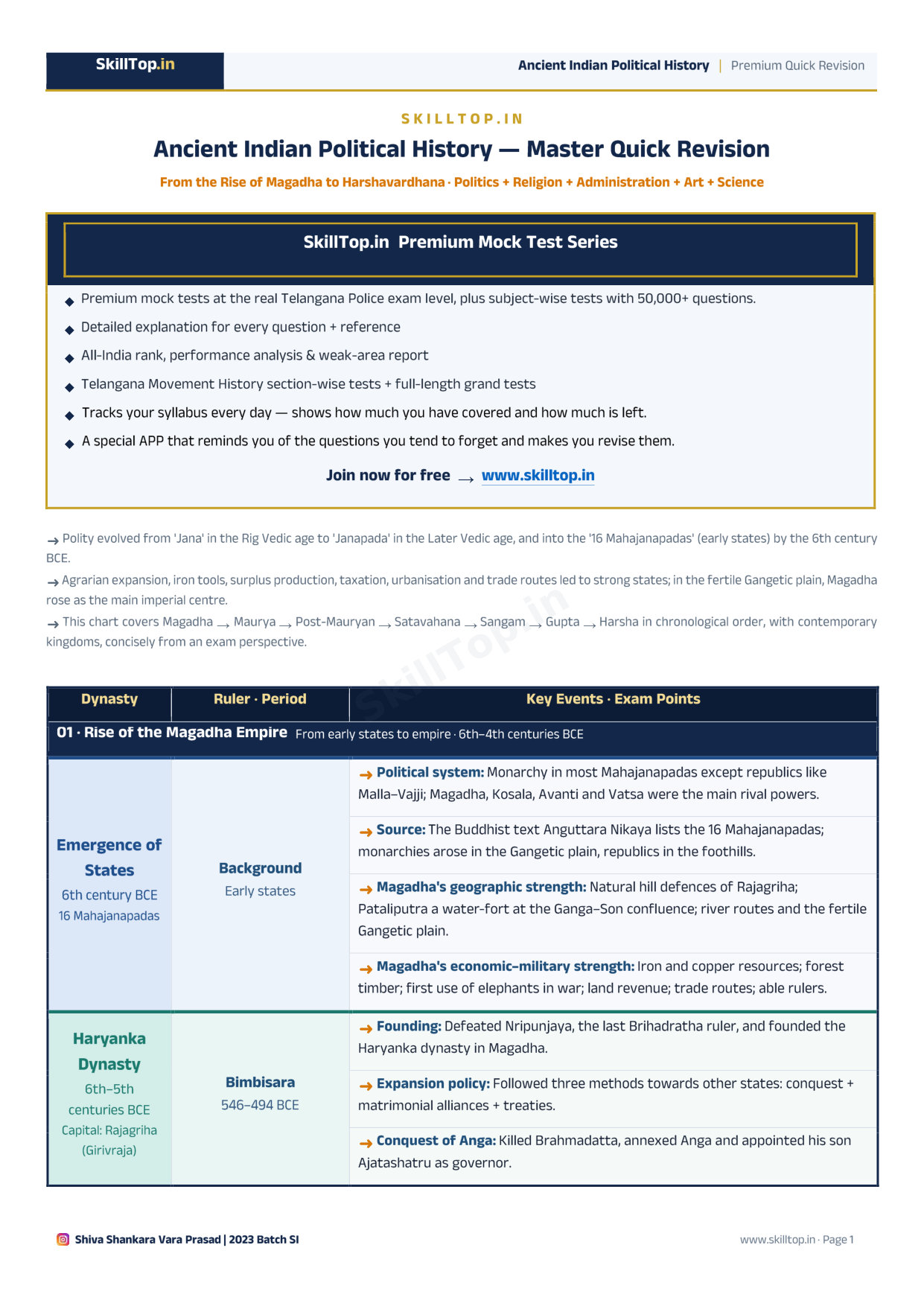
SkillTop .in Ancient Indian Political History | Premium Quick Revision Shiva Shankara Vara Prasad | 2023 Batch SI www.skilltop.in · Page 1 S K I L L T O P . I N Ancient Indian Political History — Master Quick Revision From the Rise of Magadha to Harshavardhana · Politics + Religion + Administration + Art + Science SkillTop.in Premium Mock Test Series ◆ Premium mock tests at the real Telangana Police exam level, plus subject -wise tests with 50,000+ questions. ◆ Detailed explanation for every question + reference ◆ All-India rank, performance analysis & weak -area report ◆ Telangana Movement History section -wise tests + full -length grand tests ◆ Tracks your syllabus every day — shows how much you have covered and how much is left. ◆ A special APP that reminds you of the questions you tend to forget and makes you revise them. Join now for free → www.skilltop.in ➜ Polity evolved from 'Jana' in the Rig Vedic age to 'Janapada' in the Later Vedic age, and into the '16 Mahajanapadas' (early states) by the 6th century BCE. ➜ Agrarian expansion, iron tools, surplus production, taxation, urbanisation and trade routes led to strong states; in the fertile Gangetic plain, Magadha rose as the main imperial centre. ➜ This chart covers Magadha → Maurya → Post-Mauryan → Satavahana → Sangam → Gupta → Harsha in chronological order, with contemporary kingdoms, concisely from an exam perspective. Dynasty Ruler · Period Key Events · Exam Points 01 · Rise of the Magadha Empire From early states to empire · 6th–4th centuries BCE Emergence of States 6th century BCE 16 Mahajanapadas Background Early states ➜ Political system: Monarchy in most Mahajanapadas except republics like Malla–Vajji; Magadha, Kosala, Avanti and Vatsa were the main rival powers. ➜ Source: The Buddhist text Anguttara Nikaya lists the 16 Mahajanapadas; monarchies arose in the Gangetic plain, republics in the foothills. ➜ Magadha's geographic strength: Natural hill defences of Rajagriha; Pataliputra a water -fort at the Ganga –Son confluence; river routes and the fertile Gangetic plain. ➜ Magadha's economic –military strength: Iron and copper resources; forest timber; first use of elephants in war; land revenue; trade routes; able rulers. Haryanka Dynasty 6th–5th centuries BCE Capital: Rajagriha (Girivraja) Bimbisara 546–494 BCE ➜ Founding: Defeated Nripunjaya, the last Brihadratha ruler, and founded the Haryanka dynasty in Magadha. ➜ Expansion policy: Followed three methods towards other states: conquest + matrimonial alliances + treaties. ➜ Conquest of Anga: Killed Brahmadatta, annexed Anga and appointed his son Ajatashatru as governor. SkillTop.in
SkillTop .in Ancient Indian Political History | Premium Quick Revision Shiva Shankara Vara Prasad | 2023 Batch SI www.skilltop.in · Page 2 Dynasty Ruler · Period Key Events · Exam Points ➜ Matrimonial alliances: Married princesses of Kosala, Vaishali, Videha and Madra; Prasenajit gave Kashi as dowry. ➜ Administration: Mahagovinda was the architect of the capital Rajagriha; about 80,000 villages; donated Venuvana to the Buddhist Sangha. ➜ Death: According to Buddhist texts, he was killed by his son Ajatashatru. Ajatashatru 494–462 BCE Title: Kunika ➜ Significance: Came to the throne by killing his father; apart from this cruelty, the greatest Haryanka ruler; the dynasty reached its peak under him. ➜ War with Kosala: War broke out when Prasenajit took back Kashi; it ended in a treaty and he married Prasenajit's daughter Vajira. ➜ War with the Licchavis: Sent minister Vassakara to sow discord in the Vajji confederacy and won after three years; used new weapons like Mahashilakantaka and Rathamusala. ➜ Defence: Built the Patali fort at the Ganga –Son confluence under the supervision of Vassakara and Sunidha. ➜ Buddhism: The First Buddhist Council was held at Rajagriha during his reign. Udayin (Udayabhadra) Successor of Ajatashatru ➜ Capital: Traditionally credited with developing Pataliputra as the capital; a strategic centre for controlling the Ganga valley. Quick Recall → Founder: Bimbisara · Greatest ruler: Ajatashatru · Capital: Rajagriha → Pataliputra · First Buddhist Council: Rajagriha Shishunaga Dynasty 5th–4th centuries BCE Capital: Pataliputra Shishunaga Founder of the dynasty ➜ Conquest: Annexed Avanti, Magadha's main western rival; Magadhan influence spread towards central India. Kalashoka Prominent Shishunaga ruler ➜ Buddhism: The Second Buddhist Council was held at Vaishali during his reign. Nanda Dynasty 4th century BCE Capital: Pataliputra Mahapadma Nanda Founder of the Nanda dynasty ➜ Conquests: Made Magadha a great power through wide conquests; huge army and revenue system; associated with the titles Ekarat/Ugrasena. Dhana Nanda Last Nanda ruler ➜ Downfall: Despite vast wealth and army, it lacked popular support; Nanda rule ended with defeat by Chandragupta Maurya and Chanakya. Quick Recall → Nanda founder: Mahapadma Nanda · Last ruler: Dhana Nanda · Downfall → Chandragupta Maurya + Chanakya Contemporary powers of this period → North-west India: Gandhara–Taxila (Persian, Greek influence) · South: Asmaka (banks of the Godavari)
SkillTop .in Ancient Indian Political History | Premium Quick Revision Shiva Shankara Vara Prasad | 2023 Batch SI www.skilltop.in · Page 3 Dynasty Ruler · Period Key Events · Exam Points 02 · Persian –Greek Invasions North-west & North India · 6th–4th centuries BCE Foreign Invasions 6th–4th centuries BCE North-west India Persian Invasion Achaemenids ➜ Impact: North-west Indian regions were linked to the Persian Empire; influence on administration, trade, art and the use of the Kharosthi script. Alexander Greek 326 BCE ➜ Battle of the Jhelum: Fought Porus on the banks of the Jhelum (Hydaspes), 326 BCE. ➜ Retreat: Turned back when his army refused to advance beyond the Beas river. ➜ Outcome: Indo-Greek contacts grew; the political fragmentation of the north - west favoured Chandragupta Maurya's expansion. 03 · New Religions — Jainism · Buddhism Religious–social revolution of the 6th century BCE · Political background Jainism 6th century BCE 24 Tirthankaras Vardhamana Mahavira 24th Tirthankara ➜ Significance: The 24th Tirthankara of the Jain tradition; a contemporary of the Buddha; associated with nirvana at Pavapuri. ➜ Triratna (Three Jewels): Right Faith + Right Knowledge + Right Conduct — the three paths to liberation. ➜ Five Great Vows: Ahimsa, Satya, Asteya, Aparigraha, Brahmacharya; the main goal is freeing the soul from the bondage of karma. ➜ Philosophy: Anekantavada — truth has many aspects; Syadvada — every statement holds true only from a particular viewpoint. Jain Sects –Art Spread ➜ Sects: Digambaras — nudity/strict austerity; Svetambaras — white robes; differences over the Agama canon. ➜ Spread –Art: Support of merchant communities; Prakrit language; contributions to Tirthankara sculpture, caves and temple architecture. Buddhism 6th century BCE Middle Path Gautama Buddha Shakyamuni ➜ Life: Born at Lumbini; enlightenment at Bodh Gaya; first sermon at Sarnath (Dharmachakra Pravartana); Mahaparinirvana at Kushinagar. ➜ Four Noble Truths: Dukkha (suffering); its cause; its cessation; the path leading to its cessation. ➜ Eightfold Path: Right view, resolve, speech, action, livelihood, effort, mindfulness and concentration; the Middle Path is the core idea. Buddhist Councils 4 Councils ➜ First Council: Rajagriha — reign of Ajatashatru; compilation of the Buddha's teachings; associated with Ananda and Upali. ➜ Second Council: Vaishali — reign of Kalashoka; disputes over Sangha practices and rules. ➜ Third Council: Pataliputra — reign of Ashoka; Moggaliputta Tissa; spread of Buddhist missions. ➜ Fourth Council: Kundalavana, Kashmir — reign of Kanishka; Vasumitra; linked to the rise of Mahayana. SkillTop.in
SkillTop .in Ancient Indian Political History | Premium Quick Revision Shiva Shankara Vara Prasad | 2023 Batch SI www.skilltop.in · Page 4 Dynasty Ruler · Period Key Events · Exam Points ➜ Sects: Theravada/Hinayana — individual nirvana; Mahayana — the Bodhisattva ideal; later Vajrayana. ➜ Art–Architecture: Stupa, chaitya, vihara; Gandhara –Mathura sculpture; spread to other Asian countries. Quick Recall → First Council: Rajagriha · Second: Vaishali · Third: Pataliputra (Ashoka) · Fourth: Kashmir (Kanishka) 04 · Mauryan Empire India's first great empire · 322–185 BCE Maurya Dynasty 322–185 BCE Capital: Pataliputra Chandragupta Maurya 322–297 BCE ➜ Founding: With the help of Chanakya/Kautilya, defeated Dhana Nanda, the last Nanda ruler, and founded the Mauryan Empire in 322 BCE. ➜ Historical status: According to R.K. Mookerji, India's first historical emperor; founder of the first great empire. ➜ North-west conquest: Removed the Greek power centres left after Alexander and brought north -west India under his control. ➜ War with Seleucus: Defeated Seleucus Nicator and signed a treaty; gained control over eastern Afghanistan, Baluchistan, Kandahar and Herat. ➜ Foreign envoy: Megasthenes, envoy of Seleucus, visited the Pataliputra court and wrote the Indica. ➜ Irrigation: Rudradaman's Junagadh inscription records the building of the Sudarshana lake/dam in Saurashtra in Chandragupta's time. ➜ Last phase: According to Jain tradition, went to Shravanabelagola with Bhadrabahu and ended his life by sallekhana. Bindusara 297–272 BCE Title: Amitraghata ➜ Succession: Son of Chandragupta; preserved the vast empire and continued Mauryan authority. ➜ Expansion: Mauryan influence extended further into the Deccan, bringing most of the subcontinent within the empire. ➜ Diplomatic relations: Maintained friendly relations with the Greek kings of the west. ➜ Taxila revolt: Sent his son Ashoka, then at Ujjain, to suppress the Taxila revolt; Ashoka crushed it successfully. Ashoka 273–232 BCE Devanampiya Piyadasi ➜ Importance: The most famous Mauryan ruler; his inscriptions are the main direct sources for his life, philosophy and the empire's boundaries. ➜ Kalinga War: Conquered Kalinga in the 8th year of his reign; Major Rock Edict XIII records about 1,50,000 deported and 1,00,000 killed. ➜ Turning point: Remorseful at the war's destruction, proclaimed Dhamma -vijaya instead of Digvijaya, and Dhamma -ghosha instead of Bheri -ghosha.
SkillTop .in Ancient Indian Political History | Premium Quick Revision Shiva Shankara Vara Prasad | 2023 Batch SI www.skilltop.in · Page 5 Dynasty Ruler · Period Key Events · Exam Points ➜ Extent of the empire: From Afghanistan –Baluchistan in the north -west to Bengal in the east and Kanchipuram in the south; the Chola, Pandya, Satyaputra and Keralaputra kingdoms stayed independent. ➜ Dhamma: Compassion, charity, truth, purity, courtesy; respect for parents, elders and teachers; giving up violence, cruelty, anger, deceit and hostility. ➜ Public welfare: The paternal ideal — “All people are my children”; Dhamma- yatras; appointment of Dhamma -mahamattas. ➜ Buddhism: Tradition credits Nigrodha's influence for his conversion to Buddhism; visited Bodh Gaya; took Buddhism to the international level. ➜ Third Council: Sri Lankan chronicles state that he convened the Third Buddhist Council at Pataliputra under Moggaliputta Tissa. ➜ Missionary work: Sent Mahendra and Sanghamitra to Sri Lanka, and Dhamma envoys to Burma, Sumatra, Syria, Egypt, Macedonia and other regions. ➜ Inscriptions: Mainly Prakrit in the Brahmi script; Kharosthi and Greek/Aramaic in the north -west; rock and pillar edicts are key sources on Dhamma and administration. Mauryan State System Administration Economy Culture ➜ Administration: Centralised monarchy; the emperor assisted by a Mantriparishad; officials such as Amatyas, Mahamattas, Adhyakshas, Yuktas, Pradeshikas and Rajukas. ➜ Revenue: Land revenue was the main source; state control over mines, forests, trade, crafts and irrigation; Samaharta and Sannidhata were key officers. ➜ Army: Six boards for infantry, cavalry, chariots, elephants, navy and transport – supply; the Senapati was commander -in-chief. ➜ Art–Culture: Glossy polished Mauryan pillars, the Sarnath lion capital, Barabar rock-cut caves, stupas; NBPW pottery and use of burnt bricks. ➜ Downfall: Weak successors; over -centralisation; financial strain; provincial revolts; foreign invasions; the last ruler was Brihadratha. Quick Recall → Founder: Chandragupta · Mentor: Chanakya · Foreign writer: Megasthenes · Greatest ruler: Ashoka · Turning Point: Kalinga War · Policy: Dhamma -vijaya 05 · Post -Mauryan Kingdoms North & North-west India · Shunga –Kanva, Indo-Greeks, Shakas, Parthians, Kushanas Shunga – Kanva Dynasties 2nd–1st centuries BCE Magadha Pushyamitra Shunga Founder of the Shunga dynasty ➜ Founding: Killed Brihadratha, the last Maurya, and founded the Shunga dynasty. ➜ Defence: Resisted Yavana (Indo -Greek) attacks; patronised Brahmanical religion and Vedic sacrifices. Agnimitra Shunga ruler ➜ Literary link: Hero of Kalidasa's play Malavikagnimitram. SkillTop.in
SkillTop .in Ancient Indian Political History | Premium Quick Revision Shiva Shankara Vara Prasad | 2023 Batch SI www.skilltop.in · Page 6 Dynasty Ruler · Period Key Events · Exam Points Vasudeva Founder of the Kanva dynasty ➜ Kanvas: Short Kanva rule in Magadha after the Shungas; Vasudeva is known as its founder. Indo-Greeks · Shakas · Parthians 2nd century BCE – 1st century CE North-west & Western India Menander Indo-Greek ➜ Significance: Powerful ruler of the north -west; his dialogue with Nagasena is the Milindapanha; linked to Buddhism; bilingual coins. Maues (Shakas) Shaka ruler ➜ Shakas: Ruled north-west and western India; used the administrative titles Kshatrapa/Mahakshatrapa. Gondophernes Parthian ➜ Parthians: Ruled north-west India; associated with the Christian tradition of St. Thomas. Rudradaman Western Kshatrapa ➜ Junagadh inscription: Repaired the Sudarshana lake; fought the Satavahanas; important in the tradition of Sanskrit inscriptions. Kushanas 1st–3rd centuries CE Capital: Purushapura Kujula Kadphises Founder of Kushana power ➜ Founding: United the Yuezhi tribes; ruled the north -western regions. Vima Kadphises Kushana ruler ➜ Expansion: Expanded the empire; gold coins; trade links with Rome and Central Asia. Kanishka Greatest Kushana ruler ➜ Centre: Purushapura as capital; associated with the start of the Shaka era. ➜ Buddhism: Fourth Buddhist Council in Kashmir; spread of Mahayana Buddhism. ➜ Trade –Patronage: Controlled the Silk Route; patron of Ashvaghosha, Nagarjuna, Vasumitra and Charaka. Kushana -age Art Sculptural styles ➜ Gandhara art: Greco-Roman influence; drapery folds, realistic body form, grey schist; human images of the Buddha. ➜ Mathura art: Red sandstone; indigenous style; robust figures; Buddhist, Jain and Brahmanical images. Quick Recall → Indo-Greek: Menander (Milindapanha) · Western Kshatrapa: Rudradaman (Junagadh) · Greatest Kushana ruler: Kanishka (4th Council, Mahayana) Contemporary powers of this period → North & North-west: Shaka –Kushanas · Deccan: Satavahanas · West: Western Kshatrapas · South: Sangam kingdoms 06 · Satavahanas — Deccan Post-Mauryan southern power · 1st century BCE – 2nd century CE Satavahana Dynasty 1st century BCE – 2nd century CE Deccan–Telangana Simuka (Srimukha) Founder of the dynasty ➜ Founding: Traditionally the founder of the Satavahana dynasty; early political centres linked to the Deccan –Telangana region. Krishna (Kanha) Early Satavahana ruler ➜ Consolidation: Protected the kingdom after Simuka. Satakarni I Satavahana ruler ➜ Expansion: Expanded the kingdom; performed Ashvamedha sacrifices; Naneghat inscription; associated with Queen Naganika. ➜ Prashasti: Praised as the destroyer of the Shakas, Yavanas and Pahlavas; victory over Nahapana.
SkillTop .in Ancient Indian Political History | Premium Quick Revision Shiva Shankara Vara Prasad | 2023 Batch SI www.skilltop.in · Page 7 Dynasty Ruler · Period Key Events · Exam Points Gautamiputra Satakarni Greatest ruler ➜ Source: Nasik prashasti — issued by his mother Gautami Balashri. Vasishthiputra Pulumavi Satavahana ruler ➜ Consolidation: Consolidated the empire; strengthened links with the eastern Deccan and maritime trade. Yajnashri Satakarni Last powerful ruler ➜ Trade: Coins with a ship motif; importance of maritime trade. Satavahana State System Administration Economy Art ➜ Administration: Divisions such as rashtra and ahara; Mahasenapati and Amatyas; metronymics — Gautamiputra, Vasishthiputra. ➜ Economy: Agriculture, craft guilds, towns and ports; Roman trade; lead, copper and potin coins. ➜ Religion –Art: Patronage of Brahmanism and Buddhism; Amaravati, Bhattiprolu and Jaggayyapeta stupas; Nasik and Karle caves. ➜ Literature: Prakrit language; Hala — Gathasaptashati; Gunadhya — the Brihatkatha tradition. Quick Recall → Founder: Simuka · Greatest ruler: Gautamiputra Satakarni · Source: Nasik prashasti (Gautami Balashri) · Language: Prakrit 07 · Sangam Age — The Tamil South Chera · Chola · Pandya · Contemporary southern powers Sangam Kingdoms 3rd century BCE – 3rd century CE Tamilakam Cheras — Senguttuvan Chera ruler ➜ Significance: Chera power; tradition of a northern expedition; linked to the Pattini/Kannagi cult; the world of the Silappadikaram. Cholas — Karikala Chola ruler ➜ Conquest: Victory over the Chera –Pandya alliance; built the Kallanai dam on the Kaveri; developed Puhar/Kaveripattinam. Pandyas Nedunjeliyan ➜ Significance: Centred at Madurai; patrons of Sangam poets; pearl trade; rulers such as Nedunjeliyan are mentioned. Sangam Society Sources Economy Religion ➜ Sangam sources: Tolkappiyam; Ettuttogai; Pattuppattu; Tirukkural; Silappadikaram; Manimekalai; foreign accounts of trade. ➜ Economic life: Agriculture, fishing, pearls, pepper, textiles; the ports of Muziris and Puhar; Roman trade. ➜ Society: Tinai-based descriptions of life; warrior culture; poets and panars (bards); Sangam literature on the role of women. ➜ Religion: Local deities such as Murugan and Korravai; a blend of Brahmanical, Jain and Buddhist influences. Quick Recall → Chera: Senguttuvan (Kannagi) · Chola: Karikala (Kallanai, Puhar) · Pandya: Madurai (pearls) · Language: Tamil Contemporary powers of this period → North: Kushanas · Deccan: Satavahanas · West: Western Kshatrapas · South: Chera–Chola–Pandya SkillTop.in
SkillTop .in Ancient Indian Political History | Premium Quick Revision Shiva Shankara Vara Prasad | 2023 Batch SI www.skilltop.in · Page 8 Dynasty Ruler · Period Key Events · Exam Points 08 · Gupta Empire The Classical Age · 4th–6th centuries CE Gupta Dynasty 4th–6th centuries CE Capital: Pataliputra Sri Gupta First ruler Maharaja ➜ Significance: First ruler of the Gupta dynasty; a small kingdom; title of Maharaja. Ghatotkacha Maharaja ➜ Consolidation: Successor of Sri Gupta; early consolidation of the dynasty; title of Maharaja. Chandragupta I 320–335 CE Maharajadhiraja ➜ Foundation: Married the Licchavi princess Kumaradevi; the real founder of the Gupta Empire; linked to the start of the Gupta era (320 CE). Samudragupta Great conqueror Napoleon of India ➜ Conquests: Annexed the kingdoms of Aryavarta; defeated the Dakshinapatha kings and restored their kingdoms; frontier states submitted; performed the Ashvamedha. ➜ Source: Allahabad Pillar prashasti — composed by Harisena; the main source on his conquests and policy; known by the modern epithet “Napoleon of India”. Chandragupta II 380–415 CE Vikramaditya ➜ Conquest: Victory over the Western Kshatrapas; control of the western sea - trade routes. ➜ Foreign traveller: The Chinese traveller Fa -Hien visited India during his reign. Kumaragupta Mahendraditya ➜ Rule: Preserved the empire; traditionally linked to the founding of Nalanda University. Skandagupta Last powerful ruler ➜ Resisting the Hunas: The last powerful Gupta ruler, who faced the Huna invasions; economic and military strain grew. Gupta Age Administration Economy Society Religion ➜ Administration: Bhukti → Vishaya → Grama; Uparika, Vishayapati; more decentralised than the Mauryas; growth of land grants and feudal tendencies. ➜ Economy: Agriculture was the mainstay; guilds acted like banks; land grants; gold coins (dinara). ➜ Society: The varna –caste system hardened; Fa -Hien mentions untouchability; restrictions on the status of women. ➜ Religion: Vaishnava, Shaiva and Shakta traditions; the avatara concept; bhakti; temple and image worship; religious tolerance. Gupta Literature – Science Golden Age ➜ Kalidasa: Abhijnana Shakuntalam, Raghuvamsha, Kumarasambhava, Meghaduta — flowering of Sanskrit literature. ➜ Vishakhadatta –Amarasimha: Vishakhadatta — Mudrarakshasa, Devichandraguptam; Amarasimha — Amarakosha. ➜ Aryabhata: Aryabhatiya; mathematics and astronomy; scientific explanations of the Earth's rotation and eclipses. ➜ Metallurgy: Delhi Iron Pillar — a famous example of rust -resistant metal craftsmanship.
SkillTop .in Ancient Indian Political History | Premium Quick Revision Shiva Shankara Vara Prasad | 2023 Batch SI www.skilltop.in · Page 9 Dynasty Ruler · Period Key Events · Exam Points ➜ Education: Centres of learning such as Nalanda; autonomy, land grants, religious and secular education. ➜ Sculpture –Painting: Sarnath and Mathura Buddha images; linked to Ajanta Caves 16 and 17; Buddhist stories and court scenes. ➜ Architecture: Dashavatara temple at Deogarh; early development of brick and stone temples; rock -cut cave tradition. ➜ Downfall: Weak successors; succession disputes; independence of feudatories; Huna invasions; financial strain; rise of regional powers. Quick Recall → Real founder: Chandragupta I · Great conqueror: Samudragupta (Allahabad prashasti) · Golden Age: Chandragupta II (Fa -Hien) · Era: Gupta era 320 CE 09 · Post -Gupta — Pushyabhutis · Harshavardhana 7th century CE · Contemporary Deccan Pushyabhuti Dynasty 7th century CE Thanesar → Kanauj Harshavardhana 606–647 CE ➜ Significance: Pushyabhuti dynasty; shifted the centre from Thanesar to Kanauj; dominance over much of north India. ➜ Conquests: Relations with Valabhi; conflict with Shashanka; influence in the east and north; the whole of India was not under his direct rule. ➜ Administration: Royal tours; land grants and feudal tendencies; revenue divided among administration, officials, scholars and religious donations. ➜ Religious policy: Patronised both Buddhism and Hinduism; the Kanauj assembly; the Prayag Mahamoksha Parishad; religious tolerance. ➜ Banabhatta: Court poet; Harshacharita, Kadambari; Harsha is traditionally credited with Ratnavali, Priyadarshika and Nagananda. ➜ Hiuen Tsang: Entered India in 629 CE; recorded the political and religious conditions of Harsha's time, Nalanda and Buddhist centres. Contemporary Deccan 7th century CE Badami Pulakeshin II Chalukya of Badami ➜ Checking Harsha: Halted Harsha's southward expansion at the Narmada. ➜ Source: Aihole prashasti — composed by Ravikirti. Quick Recall → Harsha (606 –647 CE): Kanauj · Poet Banabhatta (Harshacharita) · Traveller Hiuen Tsang · Southern check: Pulakeshin II (Aihole prashasti) 10 · Master Timeline Chronology of major dynasties (at a glance) Haryanka 6th–5th c. BCE · Magadha · Bimbisara–Ajatashatru (Rajagriha → Pataliputra) Shishunaga 5th–4th c. BCE · Magadha · Annexed Avanti Nanda 4th c. BCE · Magadha · Mahapadma Nanda–Dhana Nanda Maurya 322–185 BCE · Chandragupta–Bindusara –Ashoka (Pataliputra) Shunga –Kanva 2nd–1st c. BCE · Magadha · Pushyamitra Shunga SkillTop.in
SkillTop .in Ancient Indian Political History | Premium Quick Revision Shiva Shankara Vara Prasad | 2023 Batch SI www.skilltop.in · Page 10 Indo-Greek · Shaka · Parthian · Kushana 2nd c. BCE – 3rd c. CE · North-west & West · Kanishka Satavahana 1st c. BCE – 2nd c. CE · Deccan · Gautamiputra Satakarni Sangam (Chera –Chola–Pandya) 3rd c. BCE – 3rd c. CE · Tamil South Gupta 4th–6th c. CE · Pataliputra · Samudragupta –Chandragupta II (Golden Age) Pushyabhuti (Harsha) 606–647 CE · Kanauj · Harshavardhana · Contemporary: Pulakeshin II (Badami) 11 · Summary of Contemporary Kingdoms Period-wise — side by side, not one after another 6th –4th c. BCE: North → Magadha (Haryanka/Shishunaga/Nanda) · North -west → Gandhara, Persian –Greek · South → Asmaka 3rd–2nd c. BCE: North → Maurya → Shunga · North -west → Indo-Greeks · South → Sangam kingdoms (early) 1st–3rd c. CE: North & North-west → Kushanas · West → Western Kshatrapas · Deccan → Satavahanas · South → Sangam (Chera – Chola–Pandya) 4th –6th c. CE: North → Guptas · Deccan & South → Vakatakas/regional powers (traditional mention) 7th c. CE: North → Harshavardhana (Kanauj) · Deccan → Chalukyas of Badami (Pulakeshin II) 12 · One Name — One Clue EXAM MEMORY PAIRS · Person → Ruler → Work/Source Chanakya / Kautilya → Chandragupta Maurya → Arthashastra → Founding of the Mauryan Empire Megasthenes → Chandragupta → Indica → Pataliputra Nagasena → Menander → Milindapanha Rudradaman → Western Kshatrapa → Junagadh inscription → Sudarshana lake Gautami Balashri → Gautamiputra Satakarni → Nasik prashasti Karikala Chola → Kallanai dam on the Kaveri → Puhar Harisena → Samudragupta → Allahabad Pillar prashasti Fa-Hien → Chandragupta II → Gupta-age society Banabhatta → Harshavardhana → Harshacharita Hiuen Tsang → Harsha → Nalanda → 7th century Ravikirti → Pulakeshin II → Aihole prashasti 13 · Commonly Confused Topics HIGH-VALUE COMPARISON · Key for the exam Buddhist Councils → 1: Rajagriha (Ajatashatru) · 2: Vaishali (Kalashoka) · 3: Pataliputra (Ashoka) · 4: Kashmir (Kanishka) Foreign travellers → Megasthenes (Chandragupta Maurya) · Fa -Hien (Chandragupta II) · Hiuen Tsang (Harsha) Key inscriptions → Allahabad prashasti (Samudragupta) · Junagadh (Rudradaman) · Nasik prashasti (Gautamiputra Satakarni) · Aihole (Pulakeshin II) Founder – Greatest ruler → Maurya: Chandragupta – Ashoka · Gupta: Chandragupta I – Samudragupta/Chandragupta II · Satavahana: Simuka – Gautamiputra Satakarni Key work – Author → Arthashastra (Kautilya) · Indica (Megasthenes) · Gathasaptashati (Hala) · Abhijnana Shakuntalam (Kalidasa) · Harshacharita (Banabhatta)
SkillTop .in Ancient Indian Political History | Premium Quick Revision Shiva Shankara Vara Prasad | 2023 Batch SI www.skilltop.in · Page 11 Art styles → Mauryan polish (Ashokan pillars) · Gandhara (Greco -Roman, grey schist) · Mathura (red sandstone, indigenous) · Amaravati (Satavahana) S K I L L T O P . I N Premium Exam -Standard Mock Tests Not in the exam hall — experience the real exam right at home ◆ Exam -Standard Question Papers Mock tests and subject -wise tests designed as per the TSPSC, SI, Constable, Group -II & III syllabus, with 50,000+ questions. ◆ Detailed Solutions Step-by-step explanation for every question, with reference sources. ◆ All-India Rank Rank, percentile & topic -wise analysis after every test. ◆ Telangana Movement History Special Section-wise tests + full -length grand tests. Enrol Now www.skilltop.in Premium Mock Test Series • Subject -wise Tests • Daily Current Affairs Prepared by – J. Shiva Shankara Vara Prasad — 2023 Batch SI SkillTop.in